Sage green is one of the most versatile green paint colors for interiors, but choosing the right shade can be surprisingly difficult. Sage greens range from light, gray-green neutrals to warm herbal greens and deep, moody olive shades, and the same paint can look different depending on natural light, room orientation and surrounding colors.
In this guide, we compare 10 popular sage green paint colors from Benjamin Moore, Sherwin-Williams, Farrow & Ball and Behr, including their undertones, approximate LRV and the rooms they work best in. You’ll also find practical advice for choosing sage green paint, understanding how lighting affects it, and deciding between warm, cool, light and dark sage shades.
Whether you’re looking for sage green walls, kitchen cabinets, a bedroom color or a whole-house paint color, these are some of the best shades to sample before making your final choice.
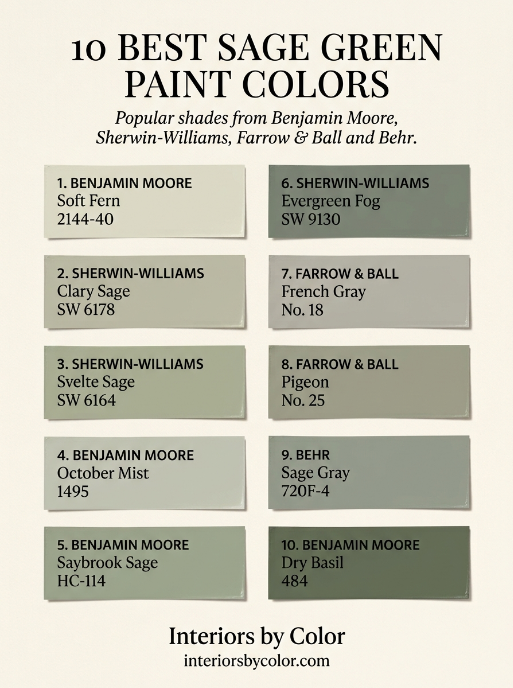
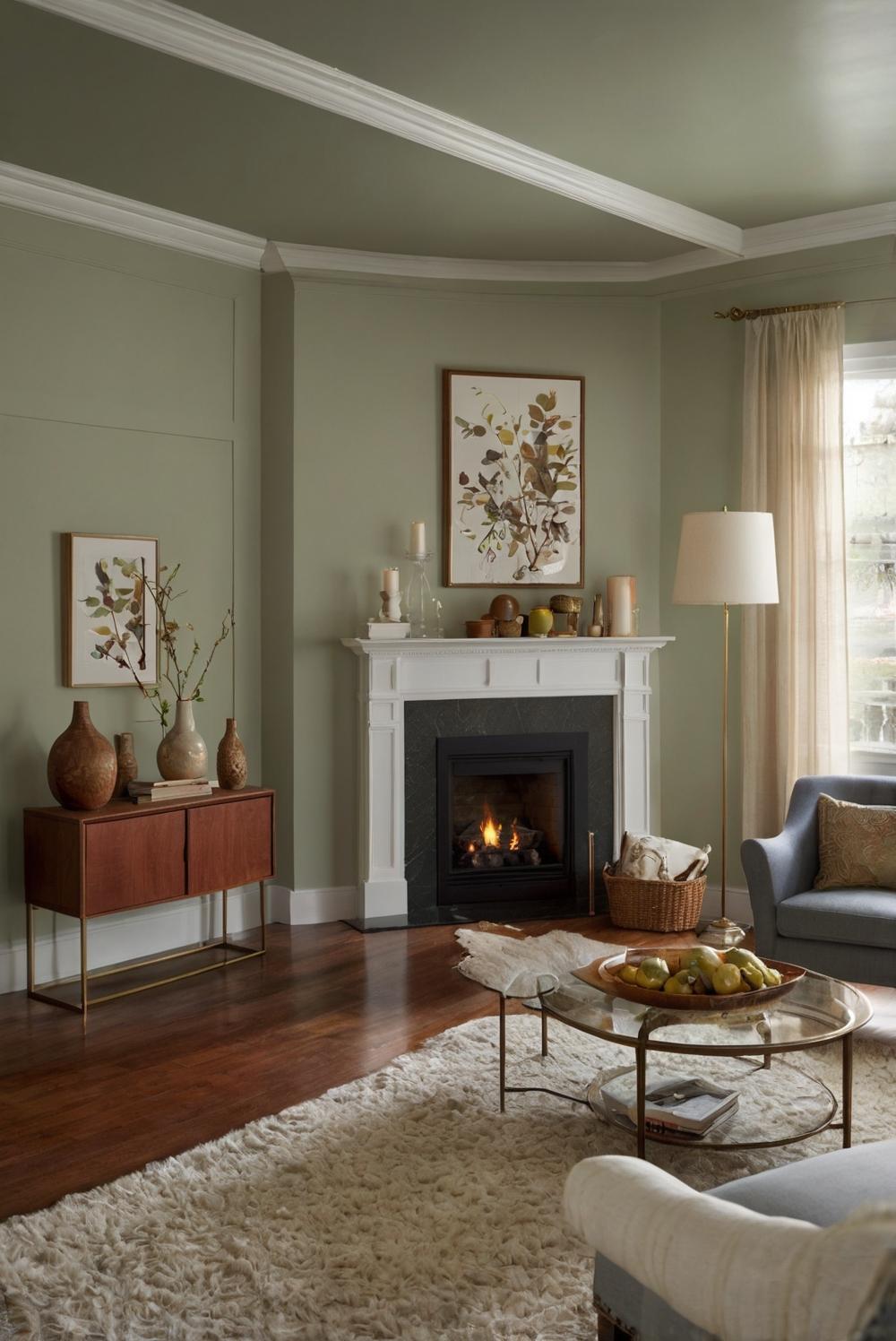
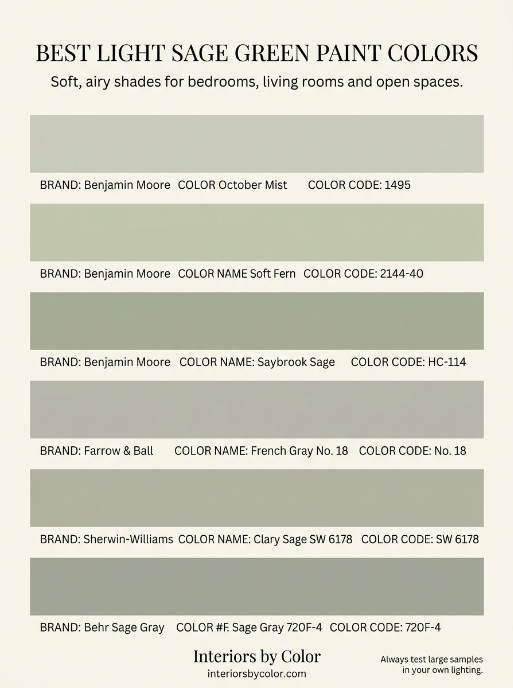
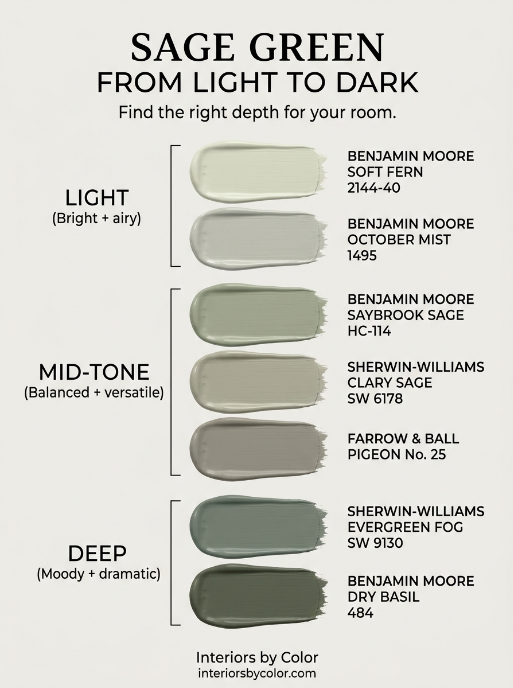
1. Benjamin Moore October Mist 1495
Best for: Living rooms, bedrooms, hallways and open-plan spaces
Undertones: Soft silver-gray
LRV: Approximately 46
October Mist was Benjamin Moore’s 2022 Color of the Year, and it’s easy to see why.
This is a soft, muted sage with a noticeable gray influence. Rather than looking like a bright green, it behaves almost like a neutral, making it particularly easy to use throughout a home.
It works beautifully with warm white, natural timber, cream, linen and brass.
If you want sage green walls without making the color the first thing you notice when you walk into the room, October Mist is one of the safest choices on this list.
2. Sherwin-Williams Clary Sage SW 6178
Best for: Kitchens, bedrooms and traditional interiors
Undertones: Warm yellow and tan
LRV: Approximately 41
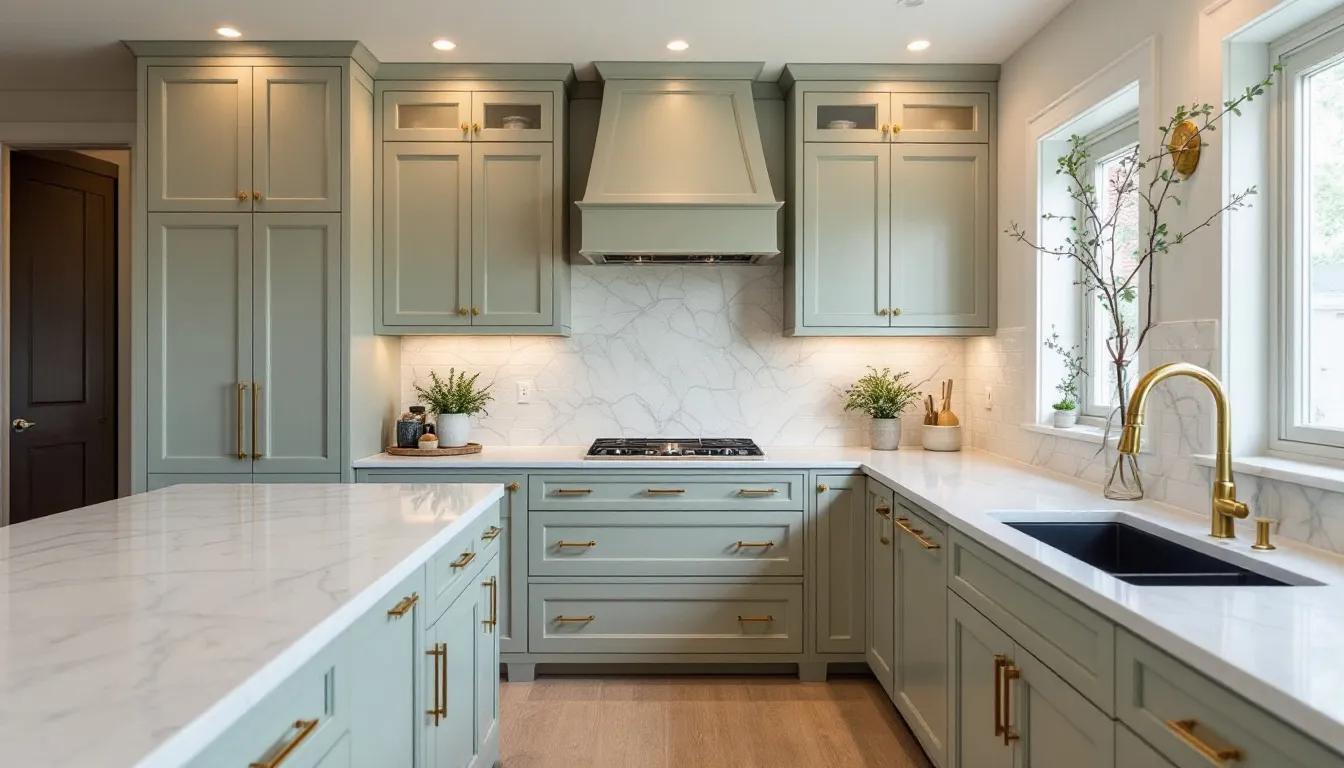
Clary Sage is a warmer take on sage green.
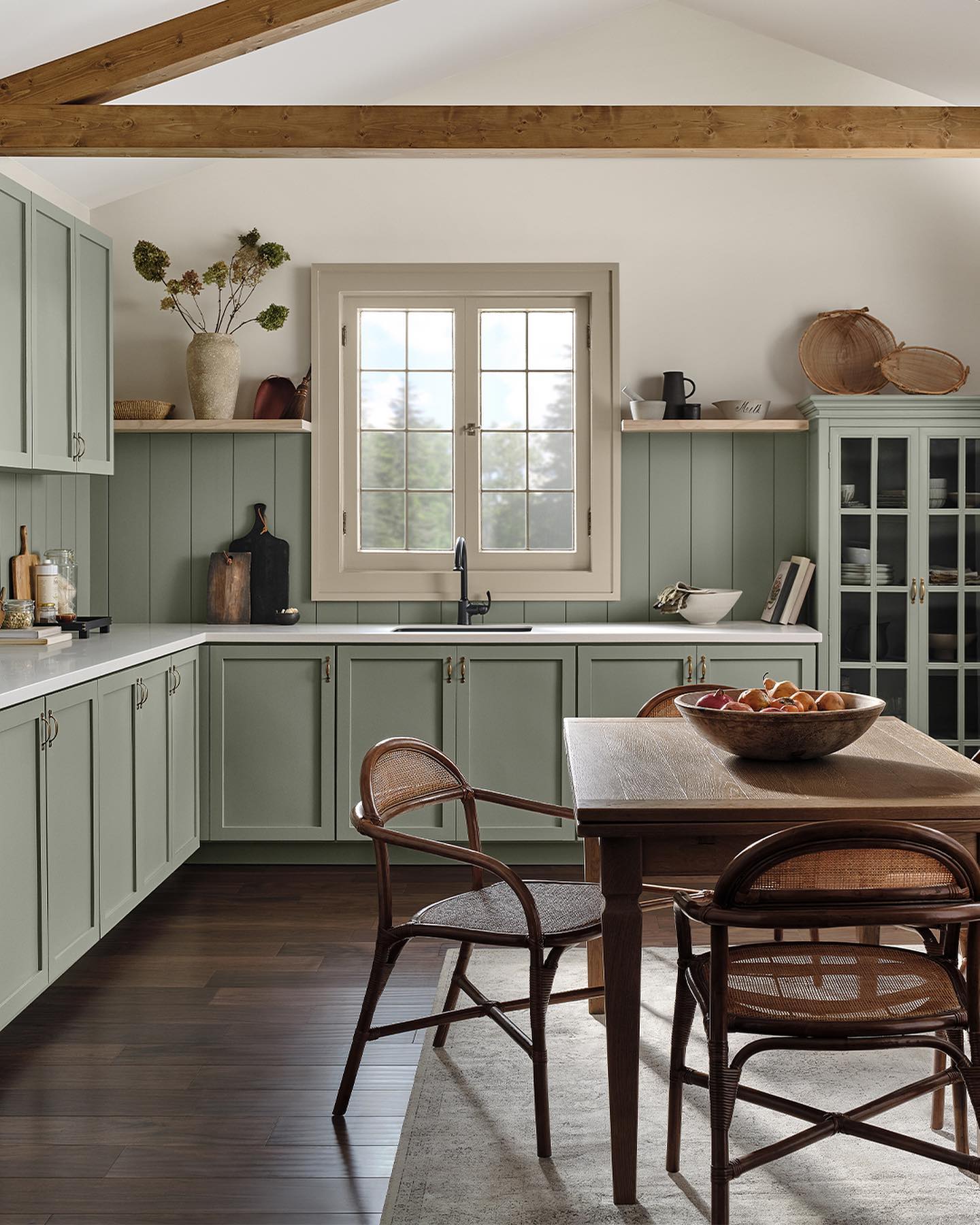
Its yellow and tan undertones give it a soft, herbal quality that works particularly well with warm wood, cream trim, natural stone and brass hardware.
It’s a good choice if you like sage but don’t want your room to feel cool or overly gray.
For a kitchen, try it on cabinetry with warm white walls and natural timber accents.
3. Farrow & Ball French Gray No. 18
Best for: Cabinetry, living rooms and traditional homes
Undertones: Warm gray
LRV: Approximately 44
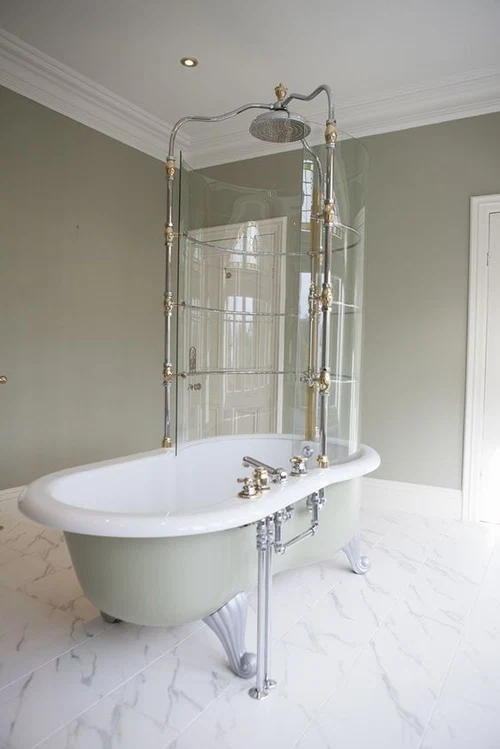
Despite its name, Farrow & Ball French Gray often reads as a soft green-gray indoors.
Its appearance changes noticeably depending on the light. In shadow, it can look quite gray, while natural daylight brings out more of its green character.
It’s particularly beautiful on kitchen cabinetry, built-ins, doors and walls where you want a subtle, sophisticated color rather than an obvious green.
4. Benjamin Moore Saybrook Sage HC-114
Best for: Traditional and modern interiors, exteriors and cabinetry
Undertones: Gray with subtle earthy brown
LRV: Approximately 45
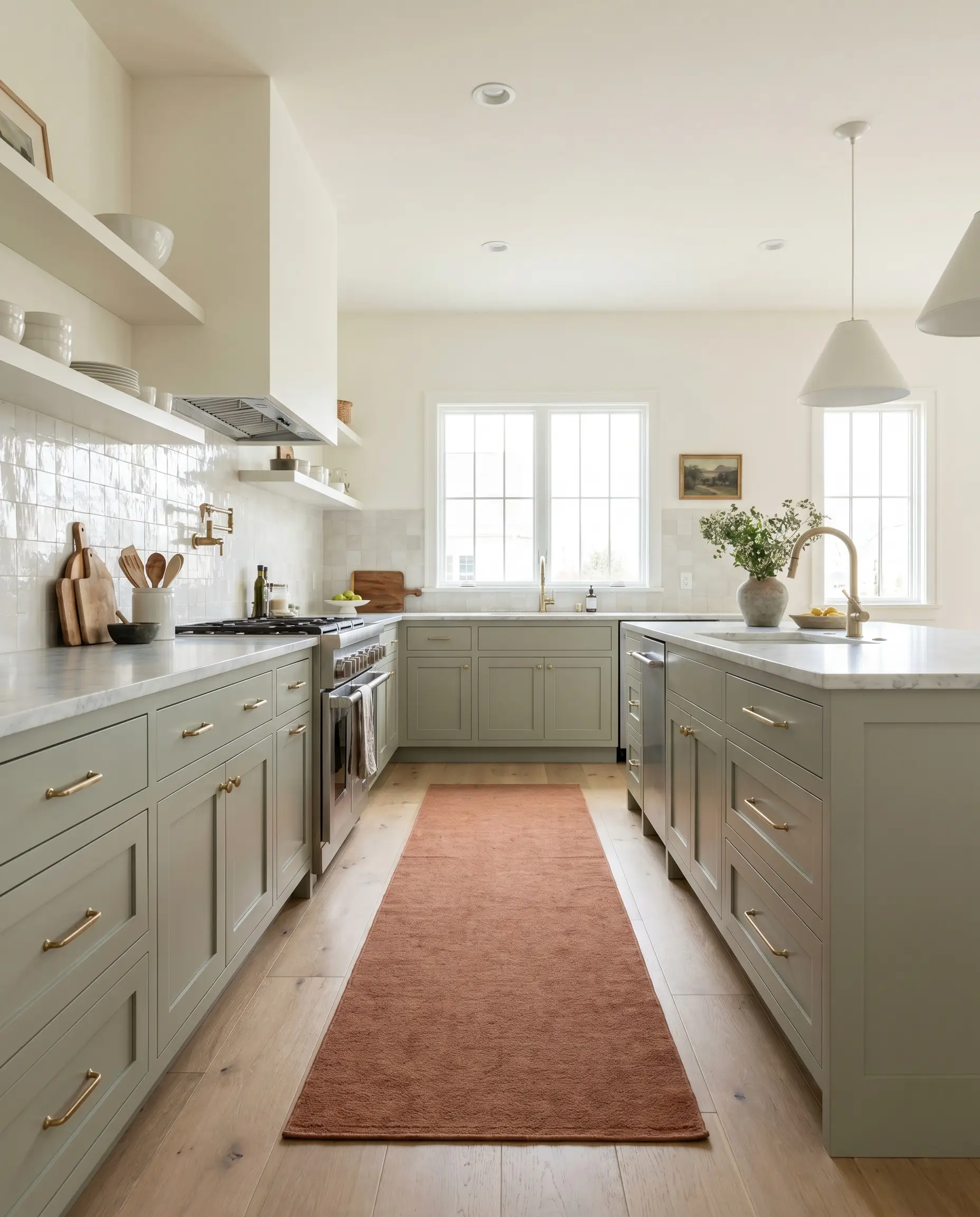
Saybrook Sage is a classic mid-tone sage.
It has enough warmth to work with traditional interiors but isn’t so warm that it looks dated. That makes it a particularly versatile choice if you’re trying to connect several rooms with one paint color.
Pair it with warm white, cream, natural wood and aged metal finishes.
It’s also one of the sage greens on this list that can work particularly well on a home’s exterior.
5. Sherwin-Williams Evergreen Fog SW 9130
Best for: Accent walls, offices, cabinetry and deeper color schemes
Undertones: Gray and blue
LRV: Approximately 30
Evergreen Fog is where sage green starts becoming more dramatic.
It’s deeper and more saturated than October Mist, with gray and subtle blue influences that give it a sophisticated, slightly moody appearance.
Use it when you want your green to be noticeable.
It’s particularly effective on kitchen cabinets, a home office, a study or a single feature wall.
6. Benjamin Moore Soft Fern 2144-40
Best for: Bright bedrooms, living rooms and smaller spaces
Undertones: Yellow-green
LRV: Approximately 56
If you’re worried that sage green will make your room feel dark, Soft Fern is worth considering.
With an LRV of around 56, it’s considerably lighter than some of the other colors here. It has a warm yellow-green quality that gives it a fresh, airy appearance.
Soft Fern works especially well when you want a noticeable green without sacrificing brightness.
7. Sherwin-Williams Svelte Sage SW 6164
Best for: Dining rooms, entryways and traditional or rustic interiors
Undertones: Gold and brown
LRV: Approximately 41
Svelte Sage is an earthy sage with stronger golden-brown undertones.
Compared with cooler sage greens, it feels warmer and more grounded.
It works particularly well with oak, walnut, leather, cream and aged brass, making it a natural fit for traditional, craftsman and rustic interiors.
8. Farrow & Ball Pigeon No. 25
Best for: Kitchen islands, built-ins, mudrooms and smaller rooms
Undertones: Blue-gray
LRV: Approximately 35
Pigeon is a cozy gray-green that can look surprisingly blue in low light.
Give it natural daylight and the green becomes much more apparent.
Because it has more depth than many pale sage colors, Pigeon is especially effective on built-ins, cabinetry and kitchen islands.
It can also look fantastic in a small powder room or mudroom where a little more color is welcome.
9. Behr Sage Gray 720F-4
Best for: Modern interiors and cooler color schemes
Undertones: Cool gray
LRV: Approximately 45
For a cleaner, cooler version of sage, consider Behr Sage Gray.
It combines muted green with slate-like gray, giving it a contemporary appearance.
It pairs particularly well with bright white trim, light oak, black accents and simple modern furniture.
If warmer sage greens feel too yellow for your taste, this is one to sample.
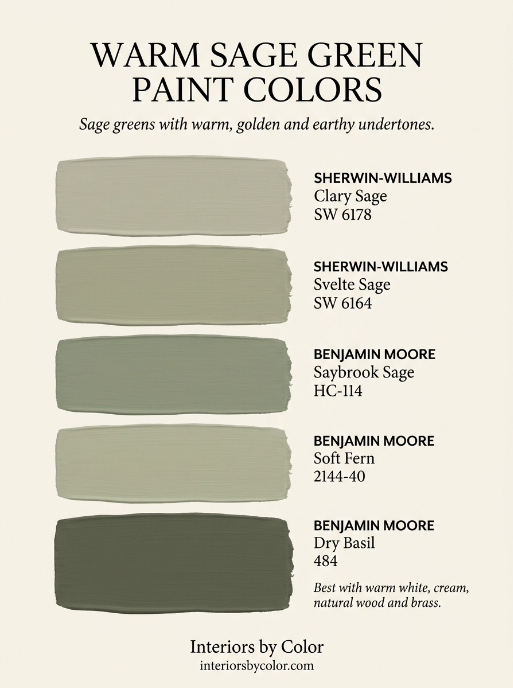
10. Benjamin Moore Dry Basil 484
Best for: Kitchen cabinets, studies, trim and accent walls
Undertones: Olive and gray
LRV: Approximately 25
Dry Basil is the dramatic option.
With a much lower LRV than the lighter shades on this list, it reads as a deep, sophisticated green that moves toward olive.
Rather than painting every wall in a small room, consider using it on cabinetry, built-ins, trim or one feature wall.
With cream, brass and warm timber, it can create a rich, cozy interior.
Sage Green Paint Color Comparison
The biggest difference between these colors isn’t simply whether they’re “light” or “dark.”
Their undertones can completely change how they look.
| Paint color | Brand | Approx. LRV | Overall feel |
|---|---|---|---|
| October Mist | Benjamin Moore | 46 | Soft and neutral |
| Clary Sage | Sherwin-Williams | 41 | Warm and herbal |
| French Gray | Farrow & Ball | 44 | Green-gray |
| Saybrook Sage | Benjamin Moore | 45 | Classic and balanced |
| Evergreen Fog | Sherwin-Williams | 30 | Deep and moody |
| Soft Fern | Benjamin Moore | 56 | Light and airy |
| Svelte Sage | Sherwin-Williams | 41 | Warm and earthy |
| Pigeon | Farrow & Ball | 35 | Cozy and blue-gray |
| Sage Gray | Behr | 45 | Cool and modern |
| Dry Basil | Benjamin Moore | 25 | Deep and dramatic |
How Lighting Changes Sage Green Paint
This is the part that’s easy to overlook.
The same sage green can look completely different from one room to another.
North-facing rooms
North-facing rooms generally receive cooler, bluer natural light.
That can make sage greens appear:
- More gray
- More blue
- Cooler
- Slightly darker
If your room has limited natural light, a warmer sage such as Clary Sage or Svelte Sage may work better.
South-facing rooms
South-facing rooms generally receive warmer, stronger natural light.
This can bring out:
- Yellow undertones
- Golden tones
- Warmer green
- More saturation
A color that looks beautifully neutral in a north-facing room could suddenly look quite warm in a sunny south-facing room.
What Is LRV and Why Does It Matter?
LRV stands for Light Reflectance Value.
It measures how much light a paint color reflects, with 0 being black and 100 being white.
For sage green, LRV can help you predict how light or dark the finished room may feel.
As a general guide:
LRV 50+: Light, bright and airy
LRV 25–45: Mid-tone, comfortable and grounded
LRV below 25: Deep, dramatic and cozy
For example, Benjamin Moore Soft Fern, with an LRV around 56, will generally feel much lighter than Benjamin Moore Dry Basil, with an LRV around 25.
But LRV isn’t the whole story. Undertones and natural light still matter.
How to Choose the Right Sage Green
Before buying several litres of paint, narrow your choices down to two or three shades.
Then consider these three things.
1. Look at your room’s exposure
Think about whether the room faces north, south, east or west.
The natural light can dramatically change the appearance of sage green.
2. Look at your existing finishes
Hold your samples next to:
- Flooring
- Kitchen cabinets
- Countertops
- Curtains
- Furniture
- White trim
- Metal finishes
A sage that looks beautiful on its own may look surprisingly yellow or blue next to your existing finishes.
3. Test the paint on the wall
Don’t rely on a tiny paint chip.
Paint large sample areas on several walls and leave them there for a few days.
Look at the color:
Morning → afternoon → evening → artificial light
You’ll quickly see which colors work and which ones don’t.
Which Sage Green Is Best?
There isn’t one perfect sage green for every home.
If you want a soft neutral, start with Benjamin Moore October Mist.
For a warm herbal green, try Sherwin-Williams Clary Sage.
For something light and airy, consider Benjamin Moore Soft Fern.
For a deeper, moodier green, look at Sherwin-Williams Evergreen Fog.
And if you want a rich, dramatic olive-sage, Benjamin Moore Dry Basil is worth sampling.
The important thing is to test the actual paint in your own room. Sage green is a chameleon, and the right color on a screen isn’t necessarily the right color on your wall.
For more paint color inspiration, visit Interiors by Color
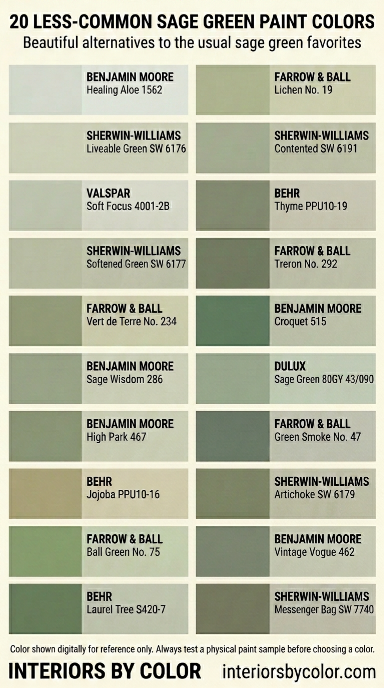
20 Less-Common Sage Green Paint Colors Worth Sampling
| # | Paint color | Brand | Character |
|---|---|---|---|
| 1 | Healing Aloe 1562 | Benjamin Moore | Very soft, pale gray-green |
| 2 | High Park 467 | Benjamin Moore | Mid-tone, earthy sage |
| 3 | Sage Wisdom 286 | Benjamin Moore | Warm, muted herbal green |
| 4 | Vintage Vogue 462 | Benjamin Moore | Deep, sophisticated olive-sage |
| 5 | Croquet 515 | Benjamin Moore | Warm, earthy green-gray |
| 6 | Softened Green SW 6177 | Sherwin-Williams | Gentle gray-green |
| 7 | Artichoke SW 6179 | Sherwin-Williams | Rich, earthy olive-sage |
| 8 | Messenger Bag SW 7740 | Sherwin-Williams | Deep, brownish green |
| 9 | Contented SW 6191 | Sherwin-Williams | Soft, subdued gray-green |
| 10 | Liveable Green SW 6176 | Sherwin-Williams | Light, warm gray-green |
| 11 | Vert de Terre No. 234 | Farrow & Ball | Soft, dusty green |
| 12 | Lichen No. 19 | Farrow & Ball | Muted, earthy green |
| 13 | Ball Green No. 75 | Farrow & Ball | Historic-looking soft green |
| 14 | Green Smoke No. 47 | Farrow & Ball | Deep, smoky blue-green |
| 15 | Treron No. 292 | Farrow & Ball | Earthy gray-green with depth |
| 16 | Jojoba PPU10-16 | Behr | Soft, warm sage |
| 17 | Laurel Tree S420-7 | Behr | Medium earthy sage |
| 18 | Thyme PPU10-19 | Behr | Deeper herbal sage |
| 19 | Soft Focus 4001-2B | Valspar | Pale, delicate gray-green |
| 20 | Sage Green 80GY 43/090 | Dulux | Classic muted sage |
Frequently Asked Questions About Sage Green Paint
There isn’t one universally best sage green, but Benjamin Moore October Mist 1495 and Sherwin-Williams Clary Sage SW 6178 are popular choices for interiors. October Mist is softer and more gray, while Clary Sage is warmer and more herbal.
For a living room, Benjamin Moore October Mist is a versatile choice because its muted gray-green appearance works well with cream, white, natural wood and neutral furniture. For a deeper look, Sherwin-Williams Evergreen Fog provides more color and contrast.
Soft, muted sage greens work particularly well in bedrooms. Benjamin Moore October Mist, Benjamin Moore Soft Fern and Sherwin-Williams Clary Sage are good options depending on whether you want a cooler, lighter or warmer result.
Sage green can be either warm or cool. Warm sage greens have yellow, tan or brown undertones, while cool sage greens tend toward gray or blue. Clary Sage and Svelte Sage are warmer examples, while Pigeon and Sage Gray have cooler characteristics.
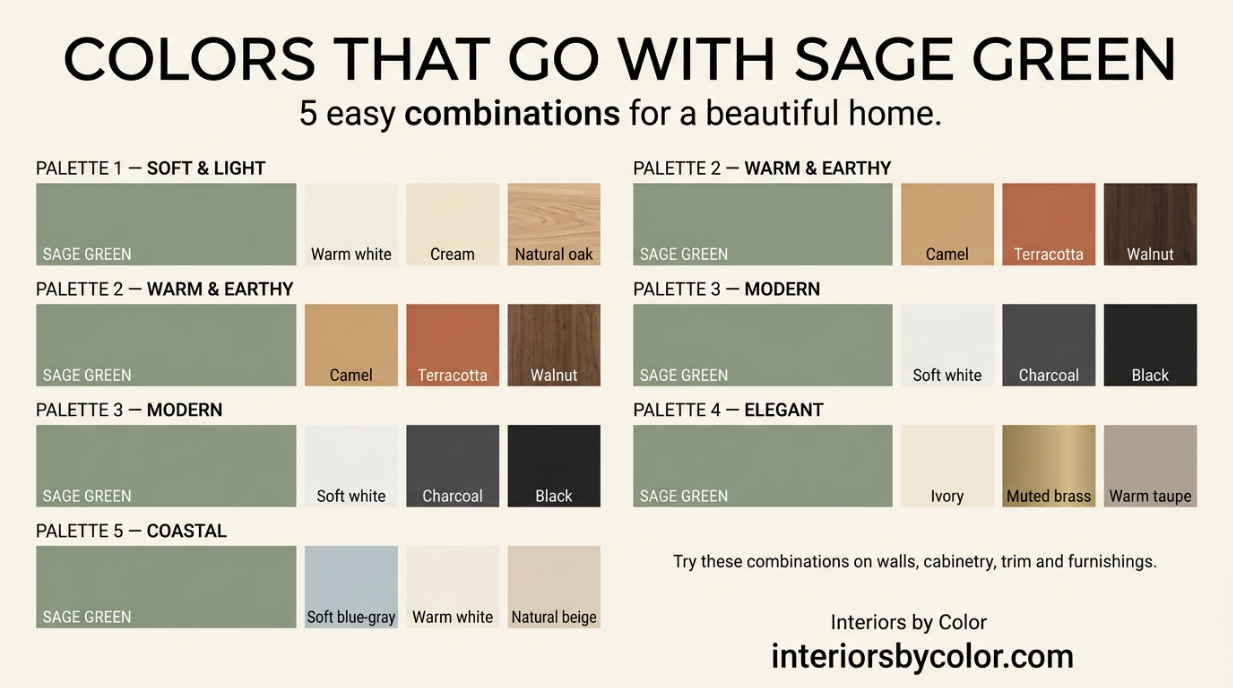
Sage green pairs particularly well with warm white, cream, beige, natural wood, taupe, brass and soft gray. Deeper sage greens can also work beautifully with charcoal, black and dark wood.
Darker sage greens can make a room feel cozier and more enclosed, particularly in rooms with limited natural light. Lighter sage greens with a higher LRV, such as Benjamin Moore Soft Fern, can help a room feel brighter and more open.
It depends on the look you want. Sage greens with an LRV above 50 generally feel lighter and airier, while shades around 25–45 create a more grounded and cozy atmosphere. Very low-LRV sage greens create a darker, more dramatic effect.
Yes. North-facing rooms receive cooler natural light, which can make sage green appear more gray, blue or slate-like. Warmer sage greens can sometimes work better in these rooms because their yellow or earthy undertones balance the cooler light.
Yes. South-facing rooms receive warmer natural light, which can bring out the yellow, golden and herbal undertones in sage green. A warm sage may therefore appear considerably warmer in a sunny south-facing room.
Yes. Sage green continues to be a popular choice for walls, cabinetry, bedrooms, kitchens and living spaces because it provides more color than a traditional neutral while remaining relatively easy to coordinate with other finishes.
Absolutely. Sage green is particularly sensitive to lighting and surrounding colors. Test a large sample on several walls and look at it in morning, afternoon and artificial evening light before choosing your final color.
Sage green is generally softer and more muted, often containing gray undertones. Olive green is typically warmer and more yellow-based, with a stronger earthy appearance. Some deeper sage colors, such as Benjamin Moore Dry Basil, sit close to the boundary between sage and olive.
For lighter cabinets, Benjamin Moore Soft Fern or October Mist can create a soft, understated look. For warmer cabinetry, Sherwin-Williams Clary Sage works well with natural wood and brass. For a deeper, more dramatic kitchen, consider Sherwin-Williams Evergreen Fog or Benjamin Moore Dry Basil.