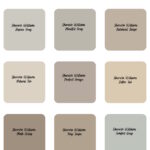
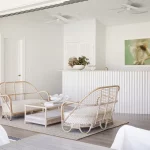
A dark hallway can make an entire house feel darker than it really is. But that doesn’t mean you have to paint it stark white.
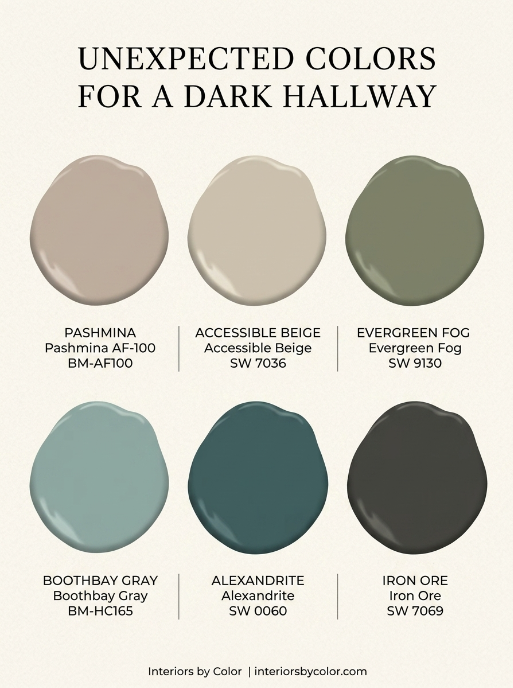
The best paint colors for a dark hallway are usually colours that reflect enough light to keep the space feeling open while adding warmth and personality. Depending on your home, that might mean a warm white, a soft greige, a muted beige, a dusty green or even a surprisingly deep colour used deliberately.
The key is to choose a colour that works with the light you actually have—not the light you wish you had.
In this guide, we’ll look at the best paint colors for dark hallways, including options from Benjamin Moore, Sherwin-Williams and Dulux, plus some less-obvious colours worth considering.
What Makes a Dark Hallway Difficult to Paint?
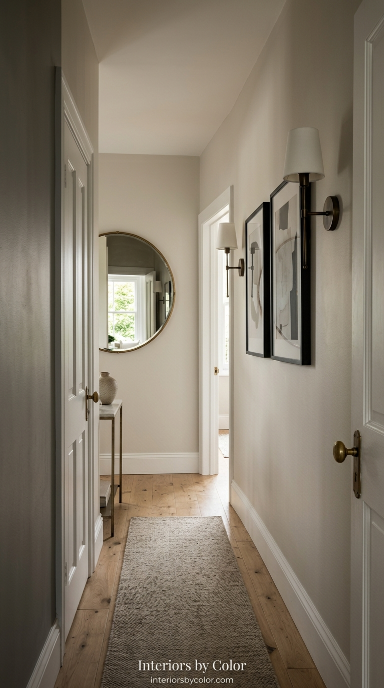
Hallways are often the darkest parts of a house because they have few or no windows. They also borrow their light from adjoining rooms.
That creates an important design issue: the same paint colour can look completely different in a hallway than it does in a sun-filled living room.
A warm neutral that looks creamy and bright in a room with large windows may look beige or slightly muddy in a windowless hallway. A cool gray can become noticeably blue or flat. And a very dark colour can make an already narrow hallway feel even more enclosed.
This is why choosing paint for a dark hallway isn’t simply about picking the colour with the highest light reflectance.
You need to consider:
- How much natural light reaches the hallway
- The colour of adjoining rooms
- Your flooring
- The colour of doors and trim
- Artificial lighting
- Whether you want the hallway to feel bright or atmospheric
- Whether the hallway is narrow or wide
Should You Paint a Dark Hallway White?
Not necessarily.
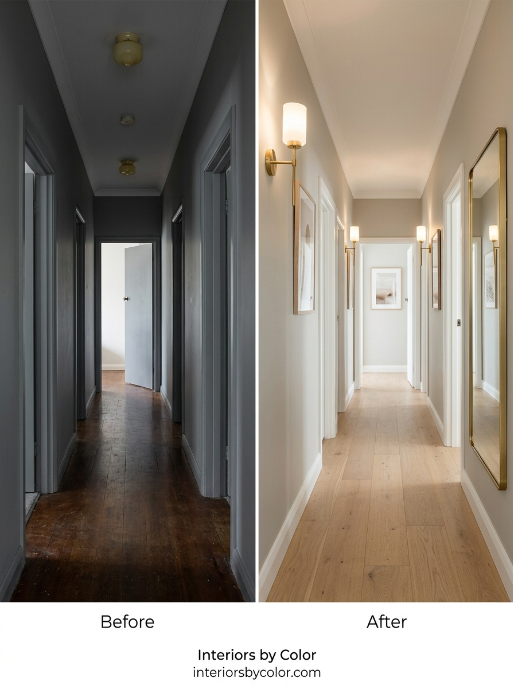
White is an obvious solution because it reflects a lot of light, but a stark white can sometimes make a dark hallway feel colder rather than brighter.
Instead, consider a warm white, creamy off-white or very pale neutral.
These colours can bounce available light around the hallway while giving the walls enough warmth to avoid looking clinical.
Best warm whites for a dark hallway
Some excellent choices include:
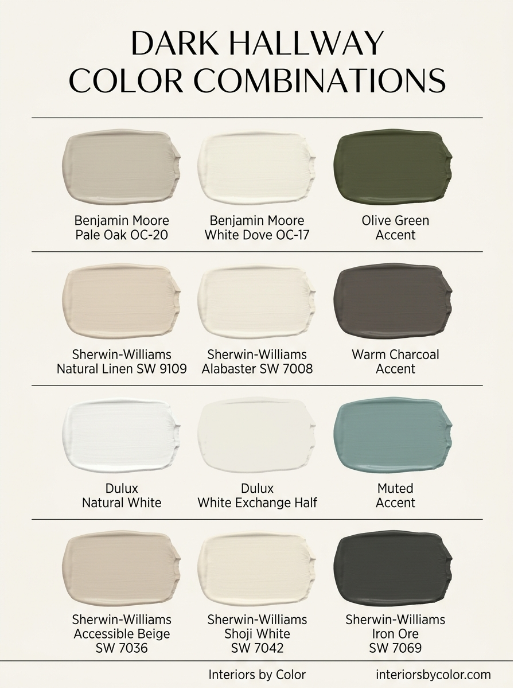
- Benjamin Moore White Dove OC-17
- Benjamin Moore Seapearl OC-19
- Sherwin-Williams Shoji White SW 7042
- Sherwin-Williams Drift of Mist SW 9166
- Dulux Natural White
- Dulux White Exchange Half
Dulux describes Natural White as its lightest warm white and specifically recommends it for brightening interiors. White Exchange Half has a subtle beige undertone and an LRV of 77, making it another useful option when you want warmth without going noticeably beige.
Interiors by Color tip: If your hallway connects several rooms painted different colours, a soft warm white is one of the easiest ways to create a visual thread throughout the house.
10 Best Paint Colors for a Dark Hallway
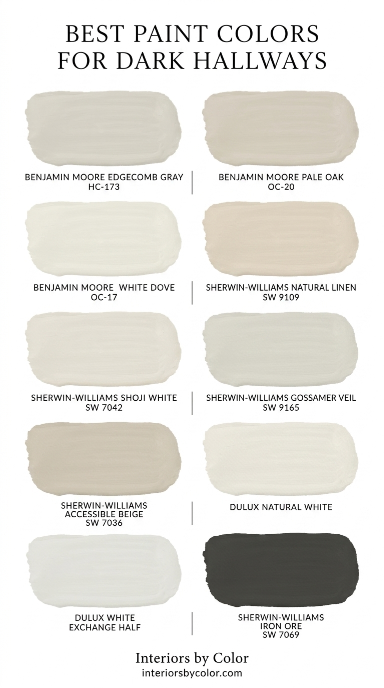
1. Benjamin Moore Edgecomb Gray HC-173
Edgecomb Gray is one of those colours that works particularly well when you don’t want white but don’t want a dark hallway either.
It is a soft, warm neutral with enough depth to give the walls definition without making the corridor feel heavy.
Benjamin Moore lists its LRV at 63.09.
Best for: Traditional, transitional and modern homes.
Pair it with: Warm white trim, oak flooring, natural timber and aged brass.
Why it works: It gives a dark hallway colour and warmth without the heaviness of a traditional beige.
2. Sherwin-Williams Natural Linen SW 9109
Natural Linen is an excellent choice if you want something warmer and more interesting than a standard greige.
It has a soft linen-like appearance that can work beautifully with timber floors and warm furnishings.
Sherwin-Williams includes Natural Linen among its expert hallway colour selections and recommends warm neutrals for hallways with limited natural light.
Best for: Warm contemporary and organic-modern interiors.
Pair it with: Natural oak, creamy whites, bronze and muted greens.
Why it works: It adds warmth without looking like old-fashioned yellow beige.
3. Sherwin-Williams Shoji White SW 7042
Shoji White is a great choice when you want the brightness of an off-white but don’t want the harshness of pure white.
It has enough warmth to make a dark corridor feel softer and more welcoming.
Sherwin-Williams specifically includes Shoji White among its recommended hallway colours and describes it as a creamy option that reflects light well.
Best for: Narrow hallways and homes with warm timber.
Pair it with: Natural oak, black accents, warm white trim and linen fabrics.
4. Benjamin Moore Pale Oak OC-20
Pale Oak is a beautiful alternative to the usual white-and-gray hallway combination.
It is soft, light and subtly warm, but it doesn’t immediately read as beige.
This makes it particularly useful if your home has a lot of natural materials or warmer flooring.
Best for: Modern traditional, transitional and minimalist homes.
Pair it with: White Dove, warm oak and muted blue-green accents.
Why it works: It gives you colour without making a dark hallway feel visually crowded.
5. Sherwin-Williams Gossamer Veil SW 9165
If you prefer a more sophisticated gray-beige, Gossamer Veil is worth considering.
It has more complexity than a basic warm white but remains light enough to work in a hallway.
Sherwin-Williams includes Gossamer Veil in its hallway colour collection.
Best for: Contemporary homes with gray, stone or mixed neutral finishes.
Pair it with: Soft white trim, charcoal, pale oak and black hardware.
6. Dulux Natural White
For Australian homes, Dulux Natural White is one of the easiest colours to shortlist.
Dulux describes it as a warm white designed to brighten spaces, with an LRV of 85.
Best for: Very dark or windowless hallways.
Pair it with: Natural timber, warm white ceilings and almost any adjoining room colour.
Why it works: It provides brightness without the starkness of a very cool white.
7. Dulux White Exchange Half
This is one of the less-obvious choices I would consider for a dark hallway.
White Exchange Half is a warm white with a subtle beige undertone and an LRV of 77. Dulux specifically describes it as suitable for main interior walls.
It is particularly useful if your home already contains warm beige, cream, timber or stone finishes.
Best for: Warm contemporary homes.
Pair it with: Natural timber, mushroom, taupe, olive and charcoal.
8. Benjamin Moore Balboa Mist OC-27
Balboa Mist is a good option if you want a hallway that feels softly gray rather than creamy.
It can work particularly well when your adjoining rooms contain cooler whites, pale gray furniture or stone finishes.
Best for: Modern and transitional homes.
Pair it with: Soft white trim, pale oak, brushed nickel and muted blue.
Watch out: In very little light, any gray can become more noticeable. Test it in the actual hallway before committing.
9. Sherwin-Williams Accessible Beige SW 7036
Accessible Beige is a useful choice when you want a warmer, deeper neutral.
It is not as bright as a white, but that can actually be an advantage if you want your hallway to feel more substantial rather than simply brighter.
Best for: Homes with warm flooring and lots of cream, tan or timber.
Pair it with: Alabaster, warm oak, bronze and earthy greens.
Why it works: The gray component keeps it more contemporary than traditional golden beige.
10. Dulux White + a Muted Colour Accent
Don’t assume every wall has to be the same colour.
A dark hallway can become much more interesting when the main walls are a light warm neutral and one architectural feature gets a muted colour.
Consider:
- Warm white walls + dusty green doors
- Warm white walls + muted blue-green artwork
- Soft beige walls + dark olive doors
- Pale greige walls + charcoal interior doors
- Warm white walls + terracotta-toned artwork
This approach allows you to introduce colour without sacrificing the brightness of the hallway.
Don’t Automatically Choose the Lightest Colour
One of the biggest mistakes people make with dark hallways is assuming that the palest possible paint will always look best.
It won’t.
A very pale cool gray can sometimes look lifeless in a hallway with artificial lighting. Meanwhile, a slightly deeper warm neutral can make the same space feel much more sophisticated.
Think about the quality of the light, not just the quantity.
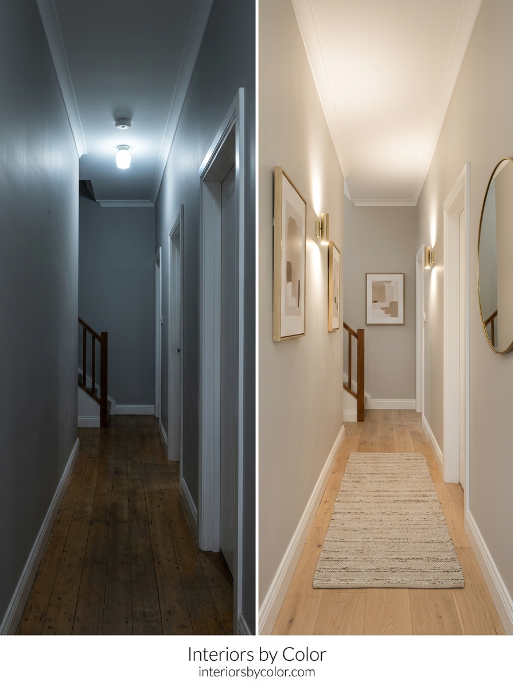
For example:
Very dark hallway
Try:
- Dulux Natural White
- Benjamin Moore White Dove
- Sherwin-Williams Shoji White
Some borrowed light from adjoining rooms
Try:
- Benjamin Moore Edgecomb Gray
- Benjamin Moore Pale Oak
- Sherwin-Williams Gossamer Veil
- Sherwin-Williams Natural Linen
Dark but you want a cozy, designer look
Try:
- Sherwin-Williams Accessible Beige
- A muted mushroom
- A soft taupe
- A dusty olive
- A deep blue-green on doors or trim
What About Dark Paint in a Dark Hallway?
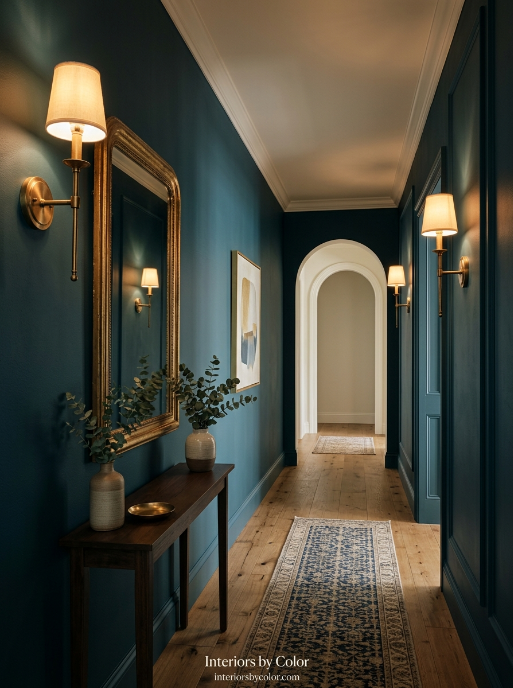
Yes—you can use it.
In fact, a dark hallway can look incredibly stylish when the darkness is intentional.
Instead of trying to make the hallway pretend to be a bright room, you can turn it into a dramatic transition between spaces.
Think:
deep olive + warm white ceiling
charcoal + aged brass
deep blue-green + creamy trim
rich brown + natural oak
The trick is to use dark colour deliberately and balance it with lighting, artwork, mirrors or lighter adjoining rooms.
Sherwin-Williams itself includes Iron Ore among its hallway recommendations for homeowners who want a bold, cozy look, particularly in larger spaces.
For a very narrow, completely windowless hallway, however, I’d generally start with a lighter colour unless you specifically want a cocooning effect.
The Best Trim Color for a Dark Hallway
Don’t forget the trim.
In a dark hallway, trim can make a surprisingly large difference.
For a soft, seamless look, use a warm white on the walls and trim.
For more definition, use:
Warm neutral walls + warm white trim
This gives the doors and architectural details a clean outline without the harsh contrast of brilliant white.
For a more contemporary look, you can also paint the doors in a deeper version of the wall colour.
For example:
Pale warm neutral walls + deep olive doors
or
Soft beige walls + charcoal doors
This is often more interesting than simply painting every door white.
Should the Ceiling Be White?
Usually, yes—but it doesn’t have to be an icy white.
A warm white ceiling can help maintain the brightness of a dark hallway without creating a jarring contrast with warm walls.
If your walls are already a warm off-white, consider using the same colour on the ceiling for a more seamless effect.
This is particularly effective in narrow hallways because there are fewer hard visual boundaries.
How Lighting Changes Your Paint Color
This is the step people skip—and it can completely change the result.
Look at your hallway:
Morning: Does it receive borrowed daylight?
Afternoon: Does the colour become warmer?
Evening: Are you using warm LED bulbs or cooler LEDs?
Night: Does the paint suddenly look gray, yellow or beige?
Paint colours should be tested in the actual hallway because surrounding colours, natural light and artificial lighting all influence how they appear. Dulux specifically recommends testing colours at different times of day and under artificial lighting.
Don’t paint the entire hallway based on a tiny sample card.
Buy a sample and paint a large section of the wall—or use a large removable sample—and look at it throughout the day.
The Best Paint Color Strategy for a Dark Hallway
If you’re overwhelmed by all the choices, start here:
For the brightest result
Dulux Natural White
For warm and sophisticated
Benjamin Moore Edgecomb Gray
For soft and contemporary
Benjamin Moore Pale Oak
For warm and modern
Sherwin-Williams Natural Linen
For a creamy off-white
Sherwin-Williams Shoji White
For a slightly deeper neutral
Sherwin-Williams Accessible Beige
For an Australian warm white
Dulux White Exchange Half
For drama
Sherwin-Williams Iron Ore
The Bottom Line
The best paint color for a dark hallway isn’t necessarily the whitest one.
Look for a colour that reflects enough available light, works with the rooms around it and complements the undertones already present in your floors, doors and furnishings.
For most homes, warm whites, pale greiges, soft beige and muted earthy colours are the safest starting points.
But don’t be afraid of colour.
A dark hallway can also be the perfect place for a deeper olive, blue-green, taupe or charcoal when you want the hallway to feel intentional rather than simply trying to make it disappear.
And above all, sample the colour in the hallway itself. The paint chip is only the beginning.
Quick FAQ: Paint Colors for Dark Hallways
What is the best paint color for a dark hallway?
Warm whites, soft greiges, pale beige and muted neutrals are usually the safest choices. Benjamin Moore Edgecomb Gray, Benjamin Moore Pale Oak, Sherwin-Williams Shoji White, Sherwin-Williams Natural Linen and Dulux Natural White are all worth considering.
What color makes a dark hallway look brighter?
Warm whites and pale warm neutrals generally make a dark hallway feel brighter because they reflect available light while preventing the space from feeling too cold.
Is gray a good color for a dark hallway?
It can be, but choose carefully. Warm grays and greiges generally work better than cool blue-gray shades in hallways with little natural light.
Should a dark hallway be painted white?
Not necessarily. A warm off-white can work better than stark white because it provides brightness while adding warmth.
Can I use dark paint in a dark hallway?
Yes. A dark hallway can look sophisticated and intentional when paired with good lighting and contrasting trim or doors. Deep charcoal, olive and blue-green can all work particularly well.
What is the best Dulux white for a dark hallway?
Dulux Natural White is a strong option because it is a warm white designed to brighten interiors. Dulux White Exchange Half is another good choice when you want a subtle beige warmth.
What is the best Sherwin-Williams color for a dark hallway?
Sherwin-Williams Shoji White and Natural Linen are good choices when brightness and warmth are the priority. Accessible Beige and Iron Ore are better options when you want more depth. Sherwin-Williams specifically includes these colours within its hallway colour recommendations.
Should hallway trim be white?
It doesn’t have to be. Warm white trim creates a classic look, while painting doors and trim in a deeper colour can create a more modern, intentional design.
See More:
How to Choose a Whole House Paint Color Scheme (Step-by-Step)